
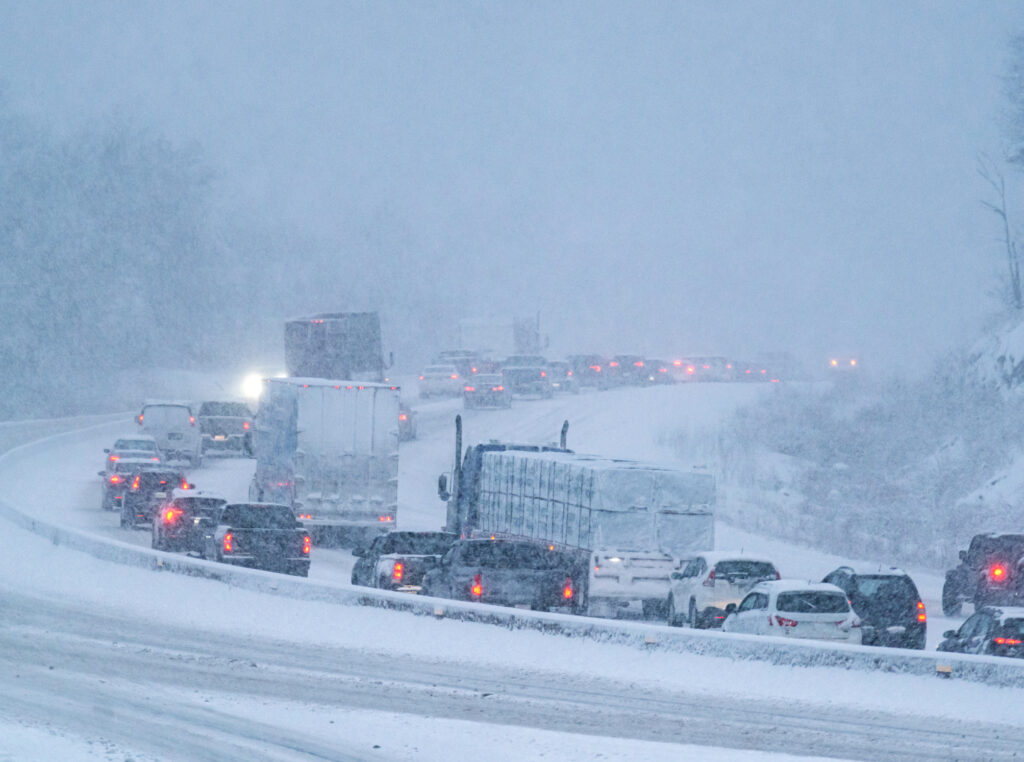
It happens all the time, every winter: a sudden whiteout on I-90, a patch of black ice on Randall Road, or freezing rain turning Route 31 into a skating rink. These conditions lead to one of the most terrifying and legally complex scenarios on the road: the multi-vehicle pileup. When three, ten, or even twenty vehicles collide in a chain reaction, the aftermath is chaotic. Determining who is at fault becomes a massive puzzle involving multiple insurance companies, conflicting witness accounts, and police investigations.
If you are involved in a chain-reaction crash, you might assume the insurance companies will “sort it out.” Unfortunately, that often means they will try to sort it out in a way that minimizes their payout, potentially leaving you with medical bills and a totaled car. This article breaks down how investigators untangle “chain-reaction” crashes, the legal concept of shared fault, and how you can recover damages even if the driver who hit you has no insurance. We also explain whynorthern Illinois personal injury attorneysare essential for protecting your interests when the finger-pointing begins.
How Fault Is Determined in Chain-Reaction Crashes
In a typical rear-end accident involving just two cars, the rear driver is almost always presumed to be at fault. But in a winter pileup involving multiple cars, liability is rarely that simple. Illinois applies principles of comparative negligence, and in multi-car crashes, “joint and several liability” or contribution among defendants often comes into play.
Investigators generally attempt to break the crash down into a series of individual impacts to assign blame. They look for the “proximate cause” of each specific injury.
- The Initial Trigger:The driver who first lost control or stopped abruptly usually bears a significant portion of the blame. This is often due to negligence, such as speeding or distracted driving, which sets the entire chain in motion.
- Following Drivers:Drivers who were following too closely (tailgating) behind the initial crash and couldn’t stop in time may be found partially at fault for subsequent impacts.
- Unavoidable Collision:Conversely, a driver who was stopped safely but was pushed into the car ahead by a third vehicle is typically notat fault.
The Role of “Too Fast for Conditions”
A common citation issued by police in these crashes is “driving too fast for conditions.” This is crucial for your injury claim. Even if a driver was traveling 40 mph in a 45 mph zone, that speed is negligent if the road is a sheet of ice. Drivers have a legal duty to adjust their behavior to the weather. OurAlgonquin personal injury lawyersfrequently use Event Data Recorders (black boxes) to prove that a defendant failed to slow down despite visible weather hazards, proving they were negligent.
Analyzing Liability Scenarios
To better understand how complex this can get, let’s look at how liability shifts in a typical three-car chain reaction.
Scenario A: The Domino EffectImagine Car A stops suddenly in the middle of the road for no valid reason (perhaps they missed a turn). Car B rear-ends Car A. Then, Car C rear-ends Car B. In this case, Car A may be liable for creating a hazard. Car B may be liable for following A too closely. Car C is almost certainly liable for hitting Car B. Each driver shares a percentage of the fault.
Scenario B: The “Push”Car A stops safely at a red light. Car B stops safely behind Car A. Then, Car C slides on ice and slams into Car B at high speed, pushing Car B into Car A. Here, Car B is generally notliable. They did everything right. Car C is responsible for the damages to both Car B and Car A. However, Car C’s insurance company might try to argue that Car B stopped too abruptly, which is why you need an attorney to defend your actions.
Scenario C: The Blind PileupIn a whiteout, Car A crashes and blocks the lane. Car B hits Car A. Minutes later, Car C hits the pile. Car A is likely liable for the initial blockage. However, if enough time passed and Car C was driving recklessly fast into a known fog bank, Car C might be fully liable for their own impact.
Whose Insurance Pays?
One of the biggest risks in massive pileups is that the total damages (dozens of totaled cars and serious injuries) will exceed the insurance policy limits of the at-fault drivers.
- The At-Fault Driver’s Liability CoverageIf one driver triggered the entire wreck, their insurance is the primary source of recovery. However, in Illinois, the minimum liability coverage is only $25,000 per person and $50,000 per accident. In a 10-car pileup, $50,000 is nowhere near enough to cover everyone’s losses.
- Uninsured/Underinsured Motorist (UM/UIM) CoverageThis is often your best route to recovery in a pileup. If the at-fault driver has low limits—or if the driver who caused the crash fled the scene (hit-and-run)—your own auto insurance policy’s UM/UIM coverage kicks in to pay the difference. Using this coverage does not typically raise your premiums if you were not at fault.
- Commercial PoliciesWinter pileups frequently involve semi-trucks, as they are harder to stop on ice. If a commercial truck was involved in the chain reaction, the trucking company likely carries a policy worth $750,000 or more. Proving the truck driver’s negligence—such as driving past federal hour limits or ignoring weather advisories—can be the key to securing full compensation for all victims involved.
What to Do at the Scene of a Pileup
Safety is the absolute priority. Chain reaction crashes are incredibly dangerous because cars continue to crash into the pile for minutes after the initial impact.
- Stay in Your Vehicle:Unless your car is on fire or in imminent danger of falling off a bridge, staying buckled inside is usually safer than walking on an icy highway where other cars are still losing control.
- Call 911:Police reports are vital for untangling the sequence of events. The officer’s diagram of the scene will be a key piece of evidence.
- Document What You Can:If it is safe to do so, take photos of the final resting positions of the vehicles, the road conditions, and the visibility.
- Do Not Admit Fault:Do not say “I couldn’t stop” or “I didn’t see him.” These statements can be used against you. Let the investigators and your attorneys determine the physics of the crash.
Why You Need a Lawyer for Multi-Vehicle Cases
In a two-car crash, it’s he-said-she-said. In a ten-car crash, it is a chaotic mix of finger-pointing. Insurance companies for every driver involved will try to shift blame to anyone else to minimize their payout. You might be blamed for hitting the car in front of you, even if you were pushed into it.
Experiencednorthern Illinois personal injury attorneysprotect you by:
- Reconstructing the Crash:We work with accident reconstruction experts who can map out the skid marks and crush damage to prove the sequence of impacts.
- Managing Multiple Claims:We coordinate with various insurers to find every available dollar of coverage.
- Defending Your Record:We ensure you aren’t unfairly assigned fault that raises your premiums or bars your recovery.
Contact Shindler & Shindler
Multi-vehicle winter crashes are confusing, high-stakes, and traumatic. Don’t let an insurance adjuster decide your role in the accident. If you’ve been injured in a pileup in Rockford, Chicago, or anywhere in between, contact ourAlgonquin personal injury lawyerstoday. We fight to ensure the true story is told and you receive the compensation you deserve.